

When you build software, you need to know each component works correctly before you connect them together. This is where unit testing comes in. It's the foundation of software quality, catching problems early and saving you from costly fixes later.
What is Unit Testing?
What is unit testing? It's a software testing method that examines the smallest testable parts of your application in isolation to validate expected behaviour. Unit testing sits at the base of the test pyramid, forming the largest layer.
Think of it like testing individual car parts before they are assembled. You wouldn't build an entire engine, then discover a faulty piston. You test each piston separately first. Unit testing applies this same logic to code.
A unit typically represents a single behaviour in your system. In procedural programming, this might be a function. In object-oriented programming, it could be a method or class. The key is isolation: you test one piece of functionality without involving databases, external APIs, or other system components.
The Test Pyramid
The Test Pyramid is a conceptual framework that suggests you should write:
- Many Unit Tests (at the base). These are fast, cheap, and focus on small, isolated pieces of code.
- Fewer Integration Tests (in the middle layer). These test how different parts of the system interact.
- Very few End-to-End (E2E) or Acceptance Tests (at the top). These simulate a user's journey through the whole application.
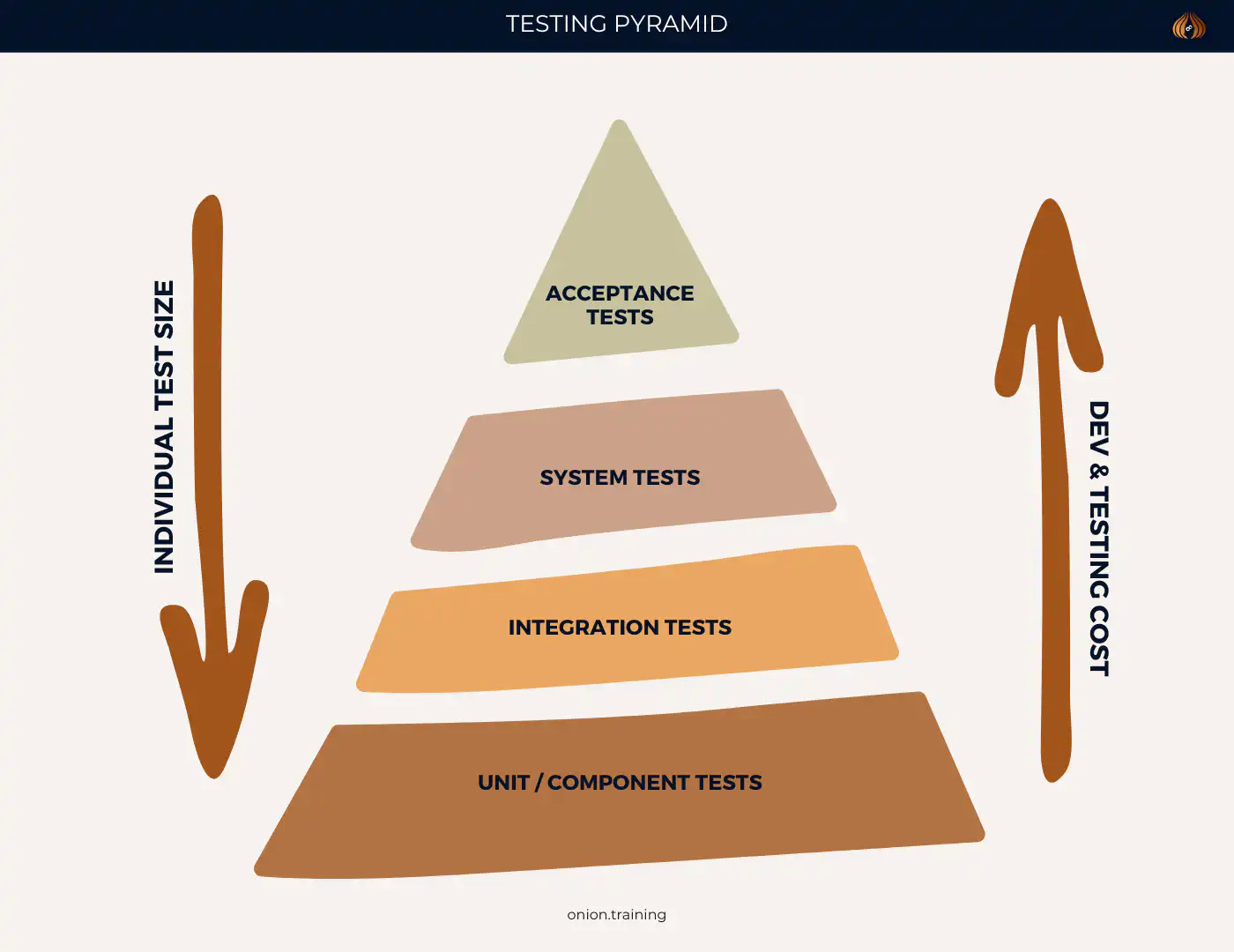
This structure prioritises unit tests because they provide the fastest feedback and are the cheapest to write and maintain, ensuring a solid foundation of quality code.
The History Behind Unit Testing Frameworks
Unit testing has evolved significantly since the 1950s. The modern automated approach began in 1989 when Kent Beck created SUnit, a testing framework for Smalltalk. This framework introduced concepts that would shape software development for decades.
The breakthrough moment came in 1997 when Kent Beck and Erich Gamma created JUnit during a flight from Zurich to the OOPSLA conference in Atlanta. They pair-programmed the first version, using test-driven development to build the framework itself. JUnit became the foundation for the xUnit family of frameworks that now exist for virtually every programming language.
The framework's simplicity has made automated testing accessible to developers worldwide, changing how software teams approach quality.
What Makes Unit Testing Different
What is unit testing compared to other test types? Several characteristics set it apart.
First, unit tests run in complete isolation. You use mock objects or stubs to simulate external dependencies like databases, file systems, or network services. This isolation keeps tests fast and predictable.
Second, unit tests focus on behaviour rather than implementation. You verify that, given specific inputs, your code produces expected outputs. You're testing what the code does, not how it does it.
Third, developers write unit tests themselves during the development process. This differs from system testing or acceptance testing, where dedicated test teams handle the work.
Fourth, unit tests execute quickly. A comprehensive test suite should run in seconds or minutes, not hours. This speed enables you to run tests frequently, identifying problems immediately.
The Cost of Finding Bugs Late
Research consistently shows that finding bugs early saves significant money and effort. Addressing software defects during the testing phase can cost 15 times more than fixing them during implementation and up to 100 times more during the maintenance phase.
A 2008 IBM report on minimising code defects found that bugs discovered during design cost one unit to fix. The same bug found just before testing costs 6.5 units. During testing, it costs 15 units. After release, the cost jumps to 60-100 units.
The National Institute of Standards and Technology estimated in a 2002 study that software bugs cost the US economy up to $59.5 billion annually. By 2016, that figure had risen to $1.1 trillion.
Real-world examples highlight these costs. NASA's Mariner 1 spacecraft self-destructed 290 seconds after launch in 1962 due to a missing hyphen in the code, costing $18 million. Toyota recalled cars in 2010 due to a software bug in the anti-lock brake system, with costs estimated at $3 billion.
Unit Testing Strategies
Effective unit testing requires covering multiple scenarios. You need to check logic paths, boundaries, error handling and object states.
Logic checks verify your code performs correct calculations and follows the right path through conditional statements. If your function has three different code paths based on input values, you need tests that exercise all three paths.
Boundary checks test edge cases. If your function accepts integers between 3 and 7, test with 3 and 7 (the boundaries), 5 (a typical value) and 9 (an invalid value). Many bugs hide at boundaries between valid and invalid inputs.
Error handling checks confirm your code responds appropriately to problems. Does it throw the correct exception? Return an error code? Prompt for new input? Your tests should verify error behaviour matches specifications.
Object-oriented checks ensure that if your code modifies persistent object states, those changes happen correctly. After calling a method that should update an object's property, verify the property actually changed.
Test-Driven Development
Test-driven development (TDD) flips the traditional development sequence. Instead of writing code and then testing it, you write tests first.
The TDD cycle follows three steps: red, green, refactor.
- First, you write a test for functionality that doesn't exist yet. The test fails (red).
- Second, you write the minimum code needed to make the test pass (green).
- Third, you refactor the code to improve its design while keeping tests passing.
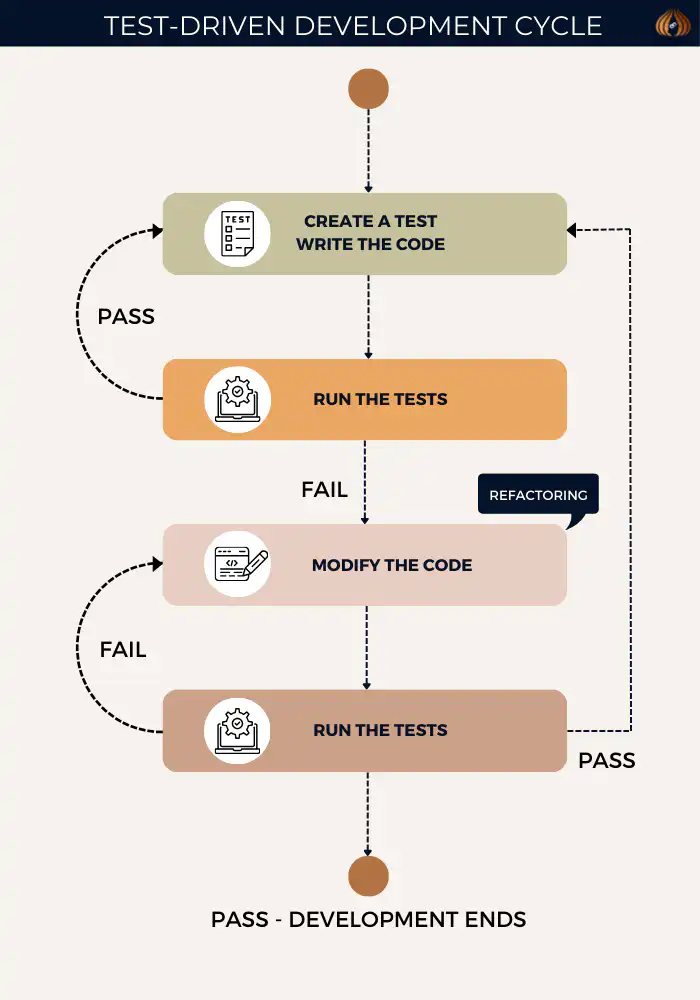
This approach offers several advantages. Tests guide your design, encouraging modular, loosely coupled code. You write only code that's actually needed, avoiding over-engineering. Every line of code comes with tests, giving you comprehensive coverage.
Benefits of Unit Testing
What is unit testing's value to your development process? The benefits extend across the entire software development lifecycle.
Early bug detection catches problems before they reach production. Unit testing enables developers to identify and fix defects before code integrates with other components, preventing defects from propagating and reducing debugging complexity.
Improved code quality results from continuous testing. You write cleaner, more modular code because testable code requires good design. Tight coupling, hidden dependencies and complex logic make testing difficult, so unit testing pushes you towards better architecture.
Faster debugging happens when tests pinpoint exact problem locations. Instead of searching through thousands of lines of code, a failing test shows you precisely which component broke.
Confidence in refactoring comes from comprehensive test coverage. You can restructure code, improve algorithms, or optimise performance, knowing tests will catch any regressions. Without tests, refactoring becomes risky guesswork.
Documentation value emerges from readable tests. New team members read tests to understand how code should behave. Tests demonstrate expected inputs, outputs and error conditions more clearly than comments often do.
Reduced maintenance costs compound over time. Code with good unit test coverage costs less to maintain because changes can be made confidently and bugs are found quickly.
Common Unit Testing Challenges
Unit testing isn't always straightforward. You'll encounter several common challenges.
Legacy code without tests presents difficulties. Retrofitting tests onto existing code takes significant effort, especially when the code wasn't designed with testing in mind. Highly coupled systems with complex dependencies resist testing attempts.
Time investment concerns arise early in adoption. Writing tests takes time, and initially this seems to slow down development. However, time savings from reduced debugging and fewer production bugs typically offset this investment within weeks.
Test maintenance becomes necessary as code evolves. Tests can break when code changes, even when functionality remains correct. This happens most often with poorly designed tests that couple too tightly to implementation details.
UI-heavy applications challenge traditional unit testing approaches. Testing visual appearance and user interaction requires different strategies. Integration tests or end-to-end tests often work better for UI components.
Rapidly changing requirements can make extensive unit testing feel wasteful. If you're in early prototyping phases where features change daily, comprehensive unit testing might not provide a good return on investment yet.
Best Practices for Effective Unit Testing
Success with unit testing requires following proven practices. These guidelines help you write tests that provide value without excessive maintenance burden.
Keep tests independent. Each test should run in isolation without depending on other tests. Tests should be able to run in any order, and running one test shouldn't affect another. Use setup methods to create fresh test data for each test.
Test one thing at a time. Each test should verify a single behaviour or condition. When a test fails, you should immediately know what went wrong. Multiple assertions testing different behaviours make debugging harder.
Use descriptive test names. Test names should clearly state what they test and the expected outcomes. Names like test_calculate_discount_returns_zero_for_hundred_percent tell you exactly what failed when tests break.
Follow the Arrange-Act-Assert pattern. Organise tests into three clear sections.
- Arrange sets up test data and conditions.
- Act executes the code being tested.
- Assert verifies results.
This structure makes tests readable and maintainable.
Mock external dependencies. Replace databases, file systems, network calls and other external systems with mock objects. This keeps tests fast, predictable and focused on your code rather than external systems.
Aim for high coverage but don't obsess. Test coverage measures what percentage of your code that runs during tests. High coverage is good, but 100% coverage doesn't guarantee bug-free code. Focus on testing important behaviours and edge cases rather than chasing coverage percentages.
Run tests frequently. Integrate tests into your development workflow. Run them before committing code, during continuous integration builds and before deployments. Fast feedback helps catch problems immediately.
Write tests first when beneficial. Test-driven development isn't mandatory for every situation, but writing tests before code often results in better design and ensures comprehensive coverage.
Popular Unit Testing Frameworks
Different programming languages have established frameworks that make unit testing easier. These frameworks provide structure for organising tests, running them and reporting results.
- For Java, JUnit remains the dominant choice. Originally released in the late 1990s, JUnit is now in its fifth major version, offering annotations for test methods, assertions for verification and integration with build tools like Maven and Gradle.
- For Python, pytest and unittest serve different needs. Unittest comes built into Python’s standard library, while pytest offers more concise syntax and powerful features like fixtures and parametrised tests.
- For .NET and C#, NUnit and xUnit.net provide comprehensive testing capabilities, and Microsoft’s MSTest integrates tightly with Visual Studio.
- For JavaScript, Jest has become the default choice for React applications, whilst Mocha and Jasmine remain popular for other JavaScript projects. These frameworks can be used for both Node.js server code and browser-based code, often with additional tooling.
- For Ruby, RSpec popularised behaviour-driven development syntax, whilst Minitest provides a simpler, more traditional approach and is included with Ruby.
Integrating Unit Tests into Development Workflows
Unit testing provides maximum value when integrated into your standard development process. Several integration points prove particularly effective.
Continuous integration (CI) automatically runs tests when code changes. When you push code to your repository, the CI system builds the application and runs the complete test suite. Failed tests prevent code from merging, maintaining code quality.
Pre-commit hooks can run relevant tests locally before you commit code. This catches problems before they reach the repository, saving time and reducing build failures.
Code review processes should include test coverage. Reviewers verify that new code includes appropriate tests and that tests actually verify expected behaviour.
Development workflow itself changes with unit testing. Many developers adopt a rhythm: write a test, write code to pass the test, refactor, repeat. This cadence becomes natural and helps maintain focus.
When Unit Testing Isn't Enough
What is unit testing unable to catch? While valuable, unit tests can't verify everything about your software.
- Integration problems between components won't appear in isolated unit tests. You need integration tests to verify that your database layer properly interacts with your business logic, or that your API correctly calls external services.
- Performance issues rarely show up in unit tests. Load testing and performance testing require different approaches that exercise entire systems under realistic conditions.
- User experience problems can't be caught by testing individual functions. UI testing, usability testing and user acceptance testing address these concerns.
- Security vulnerabilities need specialised security testing. While unit tests might catch some security bugs, dedicated security testing tools and practices remain essential.
This doesn't diminish unit testing's importance. It simply clarifies that unit testing forms one part of a comprehensive testing strategy that includes integration tests, system tests, performance tests and security tests.
Key Takeaways - What is Unit Testing?
- Unit testing examines the smallest testable parts of code in isolation, catching bugs early when they're cheapest to fix
- Fixing bugs during maintenance can cost up to 100 times more than fixing them during design, according to research on software defect costs
- The JUnit framework, created by Kent Beck and Erich Gamma in 1997, established patterns that modern testing frameworks still follow
- Unit tests must run independently using mocks or stubs to replace external dependencies like databases and APIs
- Test-driven development writes tests before code, guiding design towards modular, testable architecture
- Effective tests follow the Arrange-Act-Assert pattern with descriptive names that clearly state what they verify
- Unit testing improves code quality, enables confident refactoring and serves as living documentation for how code should behave
- Tests should run automatically through continuous integration pipelines, providing fast feedback on code changes
- Coverage percentages matter less than testing critical behaviours, edge cases and error conditions
- Unit testing complements but doesn't replace integration testing, performance testing and security testing
Frequently Asked Questions - What is Unit Testing?
Q1: What is unit testing, and how does it differ from integration testing?
Unit testing examines individual components in complete isolation, using mocks to replace dependencies. Integration testing verifies that multiple components work together correctly. If you test a database access function with a mock database, that's unit testing. If you test it with a real database connection, that's integration testing. Unit tests run faster and pinpoint problems more precisely, whilst integration tests catch issues in component interactions.
Q2: Who writes unit tests in a development team?
Developers write unit tests during the development process, rather than separate test teams. This happens because unit tests require deep knowledge of code structure and implementation. Developers write tests for their own code, or team members review and test each other's code. Test-driven development takes this further, with developers writing tests before implementing features.
Q3: When should you write unit tests?
The ideal time is during development, either before writing code (test-driven development) or immediately after. Some teams successfully write tests first to guide design. Others write code and tests together, alternating between the two. Writing tests weeks or months after code completion becomes much harder because you've forgotten design decisions and edge cases. Avoid leaving testing until just before release.
Q4: How much time does unit testing add to development?
Initially, writing tests take significant time, perhaps adding 15-30% to development schedules. However, time spent debugging drops dramatically, often by 40-60%. Within a few weeks or months, time savings from faster debugging, confident refactoring and fewer production bugs exceed the time invested in writing tests. Long-term projects see the greatest time savings.
Q5: What makes code difficult to unit test?
Several factors create untestable code. Tight coupling between components means you can't test one without involving others. Hidden dependencies make it unclear what a function needs to run. Mixing concerns, like putting business logic and database access in the same function, makes isolation impossible. Good design practices that create testable code include dependency injection, the single responsibility principle and separating concerns.
Q6: How do you handle testing code that depends on databases or external APIs?
Use mock objects or stubs to replace external dependencies. A mock database returns predefined data without actually connecting to a database. A stub API returns canned responses without making network calls. Most testing frameworks include mocking libraries. For example, Python's unittest.mock lets you replace any object with a controllable mock. This keeps tests fast and predictable. Save actual database and API calls for integration tests that verify these connections work correctly.
Q7: What's a good unit test coverage percentage to aim for?
Most teams target 70-80% coverage, though this varies by project. Critical business logic, complex algorithms and error-prone code deserve more attention than simple getters and setters. Don't obsess over 100% coverage. Some code, like simple property accessors or framework configuration, adds little value when tested. Focus on testing behaviours that matter to users and code where bugs would cause significant problems. Quality of tests matters more than quantity.
Q8: How do you prevent tests from becoming maintenance burdens?
Write tests that verify behaviour rather than implementation details. If tests break whenever you refactor code without changing behaviour, they're too tightly coupled to implementation. Keep tests simple and focused on one thing. Use clear naming and structure. Avoid duplicate test code by using setup methods and helper functions. Treat test code with the same care as production code, refactoring tests when they become messy. Delete tests that no longer provide value rather than maintaining obsolete tests.
Q9: Can you use unit testing for legacy code without existing tests?
Yes, but it requires careful strategy. Start by writing characterisation tests that document current behaviour, even if that behaviour is buggy. When you need to modify code, add tests for the specific area you're changing. Gradually expand test coverage as you work on different parts of the system. Consider refactoring small sections to make them testable before adding tests. Don't attempt to write tests for an entire legacy system at once. Using mocks and patches to handle external dependencies reduces reliance on external systems that complicate testing legacy code.
Q10: What's the difference between mocks, stubs and other test doubles?
Test doubles replace real objects during testing. Stubs return predefined responses to method calls, simulating simple behaviour. Mocks verify that specific methods were called with expected parameters, validating interactions. Spies record information about how code interacts with them, useful for investigating behaviour. Fakes implement simplified working versions of complex components, like an in-memory database. Choose based on what you need to verify: stubs for providing data, mocks for verifying calls, spies for investigating interactions and fakes for complex dependencies.
Related articles
