Continuous Delivery (CD) is a software development practice where code changes are automatically built, tested and prepared for deployment to production at any time. It ensures that software can be released quickly, safely and sustainably by keeping it in a deployable state at all times.
Key Features:
- Automated Build and Testing
- Every code change is automatically built, tested and validated using CI/CD pipelines.
- Automated tests catch issues early, reducing deployment risks.
- Frequent and Reliable Releases
- Software can be deployed at any time with minimal manual intervention.
- Reduces the time between writing code and delivering features to users.
- Version Control & Deployment Pipelines
- Uses Git, CI/CD tools (e.g., Jenkins, GitHub Actions, GitLab CI/CD), and automated pipelines.
- Ensures that every version is tracked, tested and ready for release.
- Rollback and Fail-Safe Mechanisms
- If an issue arises, automated rollback strategies minimise downtime.
- Techniques like feature flags allow testing in production without impacting users.
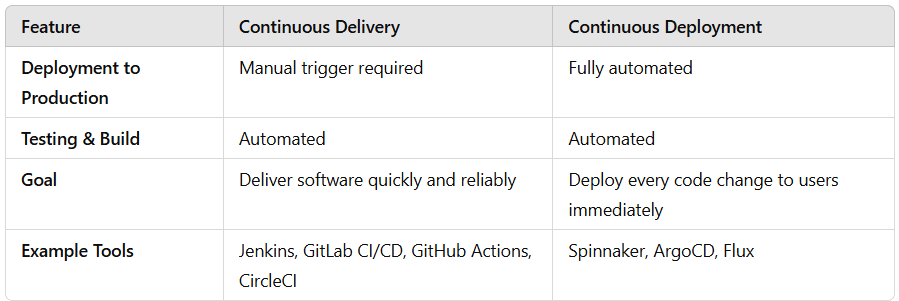
Difference Between Continuous Delivery & Continuous Deployment