
Software Testing for Schools & Colleges
Help your students discover in‑demand IT careers beyond coding with an online software testing course that’s built for beginners and simple for schools to run.
Designed for Post-16 Students
This course is ideal for students who are curious about tech but don’t see themselves as programmers. It works well for A-level Computer Science students, IT and digital learners and any post-16 student who enjoys problem-solving, attention to detail and communication.
Why Schools Need Software Testing, Not Just Programming
Modern software teams rely on Software Testers and Quality Assurance analysts to make sure the apps and systems we all use actually work. Yet most students have never heard of software testing as a career. By offering this course, your sixth form can close that gap, broaden your computing offer, and show students that there are credible, in‑demand IT roles beyond software development.
Software testing provides the missing link between classroom theory and the modern tech workplace. By introducing it, you provide:
High-Demand Roles: Introduces students to Quality Assurance (QA) and Software Testing, careers with hundreds of vacancies every month that often go unmentioned in classrooms.
Meets Gatsby Benchmark 4: The course directly links curriculum learning to careers in the tech industry – giving students a clear line of sight from the classroom to real job roles, salaries and progression pathways in software testing and quality assurance.
Bridge to Apprenticeships: Provides the specific vocabulary and foundational skills required for Level 3 and Level 4 Digital Apprenticeships.
Industry-Standard Literacy: Teaches students how professional software teams actually operate, moving beyond solo coding to collaborative quality management.
Diversifies the Computing Pipeline: Attracts students who possess strong analytical and logical mindsets but may feel alienated by programming.
Lowers the Barrier to Entry: Offers a “way in” to the tech sector for students who enjoy problem-solving and “breaking things” rather than building them from scratch.
Boosts Confidence in Logic: Builds core computational thinking skills, such as pattern recognition and boundary analysis, without the frustration of debugging complex code.
Plugs the “Theory Gap”: Turns abstract concepts like the Software Development Life Cycle (SDLC) into a practical, hands-on experience.
Scalable Enrichment: Provides a ready-to-go elective or enrichment option that requires zero additional hardware or specialist lab setups.
Approved DofE Skills Activity: Onion Training is an approved Duke of Edinburgh’s Award Activity Provider. Students can count the course toward the Skills section of their Bronze or Silver Award.
Explore our Software Testing Masterclass for Schools flipbook.
Inside, you’ll see how the course can flexibly serve as an IT extension, enrichment, or extracurricular activity, with real‑time teacher dashboards for progress monitoring, lifetime access to all materials and dedicated school pricing. You’ll also find labour‑market data, example career paths and routes into apprenticeships or university.
This flipbook is ideal for headteachers, heads of sixth form, careers leaders and curriculum planners preparing their offer for 2026/27. Download the flipbook to explore the full details or get in touch with us directly to discuss how software testing can fit into your setting.
What Students Learn on the Course
The course is broken into 12 clear modules that take students from “What is software testing?” through to practical test design and defect reporting skills.
Understanding software quality, the SDLC and Agile ways of working.
Core testing concepts, standards and documentation.
Test planning, test cases, traceability and defect management.
Functional and non‑functional testing types, including API, performance and security.
Hands‑on practice reviewing test sites, writing test cases and reporting bugs.
Easy for Schools and Colleges to Deliver
Software testing provides the missing link between classroom theory and professional software development teams. The course is delivered fully online through structured modules, meaning staff do not need prior industry experience to support their students. The content is beginner-friendly and designed to run on existing school IT systems, making it a simple addition to your enrichment offer, study programmes, or digital skills pathways.
Why it works for your staff:
No Specialist Software Required: Students can access everything through a standard web browser on existing school hardware.
Structured Learning Path: Content is logically sequenced to keep students on track without constant teacher intervention.
Comprehensive Tutor Support: Clear guidance is provided so any staff member can confidently facilitate the sessions.
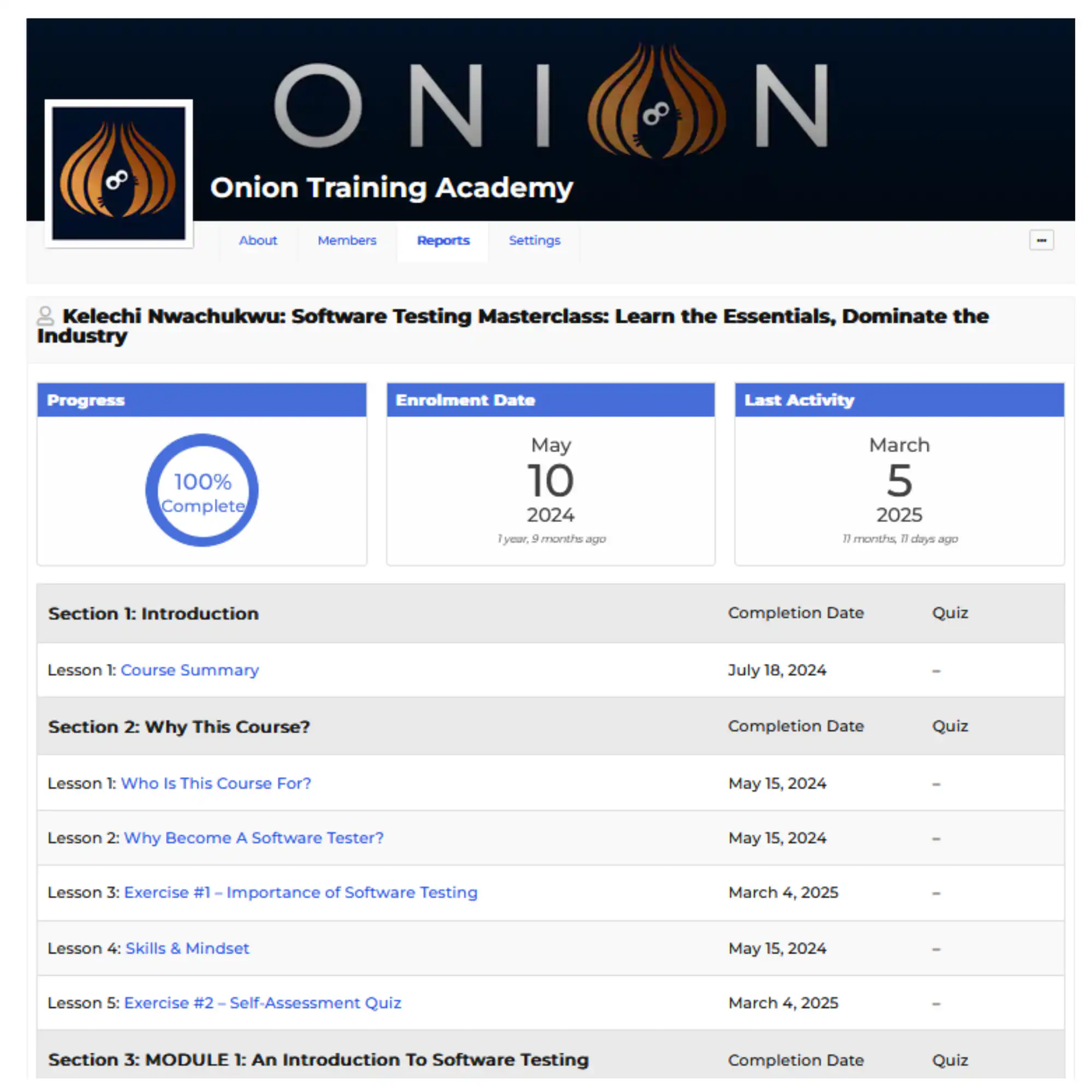
Live Progress Dashboards: Real-time tracking gives teachers a clear view of student activity and completion status at a glance.
Reduced Admin Burden: Automated logging removes the need for manual record-keeping, providing ready-made data for tutorials and parents’ evenings.
Practical Skills and Career Progression
By the completion of the course, students will have a firm grasp of how professional testing teams operate. They will understand how quality assurance fits into the wider software development lifecycle and will be able to produce their own professional test cases and defect reports.
This course provides a realistic foundation for roles such as Junior Software Tester, QA Analyst, and Test Automation Trainee. These practical skills significantly strengthen applications for digital apprenticeships, further education, and university degrees.
Student Outcomes:
Professional Documentation: Ability to write clear, structured bug reports and test plans.
Industry Literacy: Understanding of how modern tech teams collaborate to release software.
Analytical Thinking: Enhanced logic and problem-solving skills applied to real-world scenarios.
Career Readiness: A defined understanding of the QA career path and entry requirements.
Duke of Edinburgh’s Award – Approved Activity Provider
Onion Training is an approved Activity Provider for the Duke of Edinburgh’s Award. The Software Testing Masterclass counts toward the Skills section of the Bronze and Silver Awards, covering both the three-month and six-month requirements.
For schools already running a DofE programme, this means students can log the course as their Skills activity.
On completion, each student receives a Personalised Assessor’s Report and a Completion Certificate.
We are generous with our knowledge because we know it is most powerful when shared. By integrating Onion Training into your curriculum, you are giving your students a head start with decades of professional expertise, simplified and structured for their success.