TCP/IP is a suite of communication protocols used to interconnect networked devices on the internet and private networks. It defines how data should be packetized, addressed, transmitted, routed and received.
Key Components
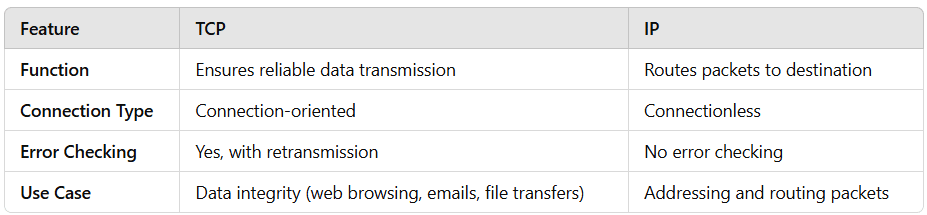
TCP/IP consists of two primary protocols:
- Transmission Control Protocol (TCP)
- Ensures reliable, ordered and error-checked delivery of data.
- Breaks data into packets and reassembles them at the destination.
- Establishes a connection before data transfer (connection-oriented).
- Example: When you load a webpage or send an email, TCP ensures the complete data reaches you correctly.
- Internet Protocol (IP)
- Handles addressing and routing of packets across networks.
- Each device has a unique IP address for identification.
- Works in a connectionless manner, meaning it does not establish a dedicated path before sending data.
How TCP/IP Works
- Data is broken into small packets.
- IP determines the best route for each packet to reach its destination.
- TCP ensures all packets arrive, are in the correct order and are error-free.
- The receiver reassembles packets into the original message.
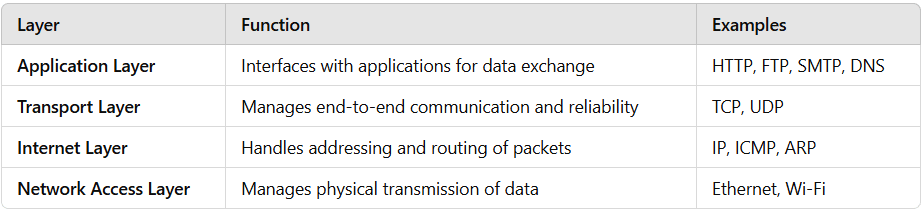
TCP/IP Model Layers
TCP/IP is divided into four layers (compared to the OSI model’s seven layers):
Why is TCP/IP Important?
- Standardised Communication: Forms the backbone of the internet.
- Reliable Data Transfer: TCP ensures messages arrive complete and correct.
- Scalability: Supports small networks to global internet infrastructure.
Comparison: TCP vs. IP